课题组邵富林同学于《Environmental Research》期刊上发表了题为《Molreac-Oxi: An end-to-end deep learning-quantum chemistry platform for •OH reactivity (kOH), pathways, and active-site insight》的论文。
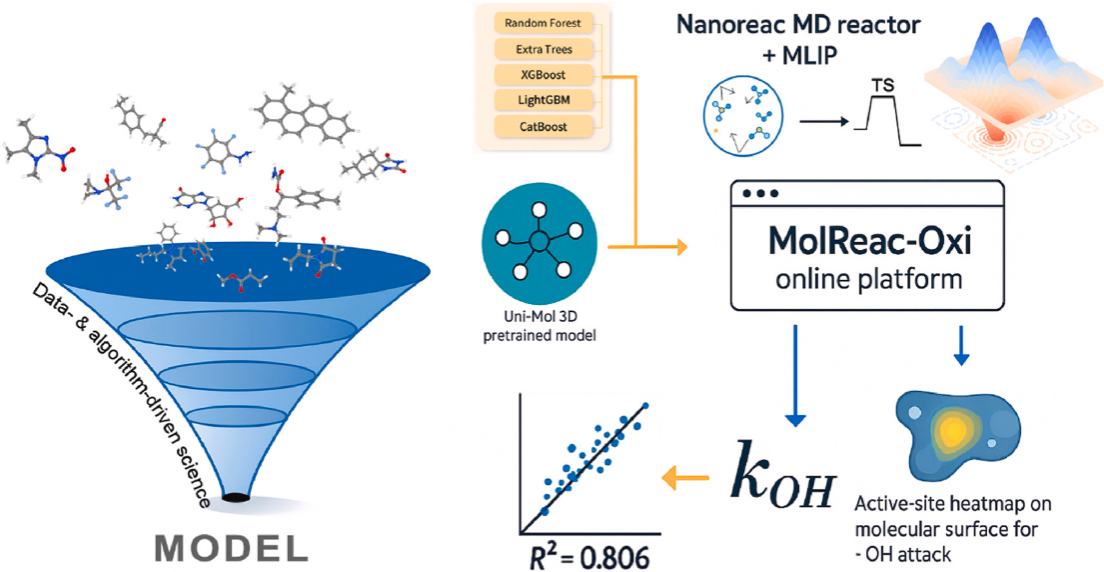
准确评估污染物与羟基自由基(•OH)的反应速率常数(kOH)是环境污染控制中的长期难题。本研究构建了融合深度预训练模型与传统机器学习的混合元模型框架,并集成了预测、机理推断和在线分析平台。基于密度泛函理论(DFT)优化结构,提取了968种污染物的多维量子化学描述符,并对大规模预训练三维分子模型Uni-Mol进行微调;随后将微调后的Uni-Mol与随机森林、梯度提升、XGBoost、LightGBM和CatBoost等第一层学习器堆叠,由正则化线性元学习器融合输出以预测kOH。结果表明,堆叠集成模型在测试集上达到R²=0.806,MAE低于任何单一学习器,log10(kOH)的 parity 图和残差诊断显示其主要化学类别间偏差有限。研究进一步利用SHAP和条件相关感知效应估计增强可解释性,并报告bootstrap支持的阈值以避免对共线描述符的过度解读。为弥补静态结构—性质模型在势能面分辨率上的不足,研究还将基于72,502种有机污染物训练的PES-Learn模型与纳米反应器分子动力学工作流耦合,从而以接近DFT的保真度和低数个数量级的成本生成机理级假设;在GPU上推理相比传统DFT加速最高约3.1×10⁴倍。上述模型与CDFT分析被封装于在线平台Molreac-Oxi(https://www.bohrium.com/apps/molreac-oxi),提供从快速批量筛选到反应路径和活性位点分析的闭环工作流,可为污染物降解动力学的快速评估和机理解析提供平台化工具。
Abstract
To address the long-standing challenge of efficiently evaluating reaction rate constants (kOH) for pollutant-hydroxyl radical (•OH) systems in environmental pollution control, a hybrid meta-model framework is introduced that fuses deep pretrained models with traditional machine learning, together with an integrated platform that unifies prediction, mechanistic inference, and online analysis. From DFT-optimized structures, multidimensional quantum-chemical descriptors were extracted for 968 pollutants, and a large-scale pretrained 3D molecular model (Uni-Mol) was fine-tuned. The fine-tuned Uni-Mol model was stacked alongside first-layer learners—Random Forest, Gradient Boosting, XGBoost, LightGBM, and CatBoost—whose outputs were fused by a regularized linear meta-learner to estimate kOH. The stacked ensemble attains R² = 0.806 with a lower MAE than any single learner, and parity plots and residual diagnostics for log10(kOH) indicate limited bias across major chemical classes. Interpretability is enhanced with SHAP (SHapley Additive explanations) and conditional, correlation-aware effect estimates; where appropriate, bootstrap-supported thresholds are reported to avoid over-interpreting collinear descriptors. To compensate for the limited PES (potential-energy-surface) resolution of static structure-property models, a PES-Learn model trained on 72,502 organic pollutants is coupled to a nanoreactor MD workflow so that mechanism-level hypotheses can be generated at near-DFT fidelity and orders-of-magnitude lower cost; on a GPU, inference achieves speedups of up to ~3.1 × 10⁴ over conventional DFT. These models and CDFT analysis are encapsulated in an online platform (https://www.bohrium.com/apps/molreac-oxi), providing a closed-loop workflow from rapid batch screening to reaction-pathway and active-site analysis.
Keywords
Hydroxyl radical (•OH); kOH rate constant prediction; Pollutant degradation kinetics; Environmental chemistry; Quantum-chemical descriptors; Deep learning
【文章链接】https://doi.org/10.1016/j.envres.2026.123763