课题组周宇同学作为共同作者于《Journal of Colloid and Interface Science》期刊上发表了题为《Biofouling behavior and control in metallic membrane treatment of algae-laden water: exploring the diverse impacts of oxidation》的论文。
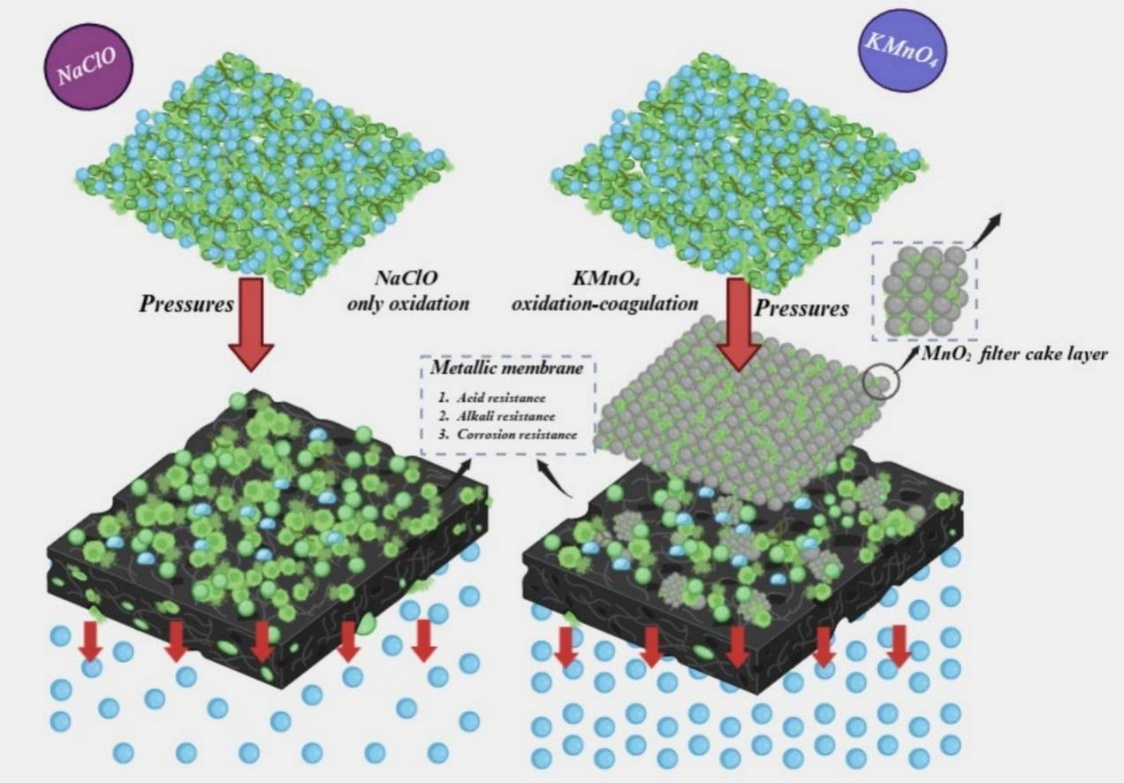
膜生物污染是含藻水超滤处理中的关键难题,尤其对于耐腐蚀金属膜而言,氧化剂与藻细胞的相互作用会显著影响污染行为。本研究系统比较了高锰酸钾(KMnO₄)和次氯酸钠(NaClO)预氧化对金属膜生物污染控制的不同影响,并结合三维荧光、SEM、流式细胞术和多尺度机理模型进行分析。结果表明,两种氧化剂均能实现较高的藻去除率(>86%),但KMnO₄凭借氧化—混凝双重功能表现出更优的污染缓解效果。低剂量KMnO₄(0.01—0.05 mmol/L)可选择性降解游离有机物而不破坏藻细胞完整性,形成可渗透的MnO₂—有机物复合层,使不可逆污染阻力Rir降至0.12(NaClO为0.31);较高浓度KMnO₄(0.05—2 mmol/L)可控制性氧化胞内有机物,将碎片包裹于多孔富MnO₂滤饼层中,通量恢复率超过95%。相反,NaClO会引起剂量依赖的细胞裂解,释放难降解的小分子有机物(<3 kDa),加剧不可逆孔堵塞,2 mg/L时Rir高达0.40。机理模型显示,KMnO₄使污染由孔堵塞主导(n=2.2)转向滤饼层主导(n<0),而NaClO则强化了标准堵塞动态;金属膜固有的氧化稳定性进一步放大了KMnO₄的优势,且膜形貌未发生明显变化。该研究为含藻水处理中预氧化策略的选择和金属膜应用提供了机理依据。
Abstract
Membrane biofouling remains a critical challenge in ultrafiltration (UF) systems for algae-laden water treatment, particularly in corrosion-resistant metallic membranes where oxidant-algae interactions dictate fouling dynamics. This study systematically evaluates the divergent impacts of potassium permanganate (KMnO₄) and sodium hypochlorite (NaClO) pre-oxidation on biofouling control, integrating multi-scale characterization (3D fluorescence, SEM, flow cytometry) with mechanistic modeling. While both oxidants achieved high algal removal (>86%), KMnO₄ demonstrated superior fouling mitigation via dual oxidation-coagulation functionality. At low doses (0.01–0.05 mmol/L), KMnO₄ selectively degraded free organic matter without compromising algal cell integrity, forming a permeable MnO₂–organic composite layer that reduced irreversible fouling resistance (Rir 0.12 for KMnO₄ vs. 0.31 for NaClO). Higher KMnO₄ concentrations (0.05–2 mmol/L) triggered controlled oxidation of intracellular organics, encapsulating debris into a porous MnO₂-rich cake layer with enhanced reversibility (flux recovery >95%). In contrast, NaClO induced dose-dependent cell lysis, releasing recalcitrant <3 kDa organics that exacerbated irreversible pore blockage (Rir up to 0.40 at 2 mg/L). Mechanistic modeling revealed KMnO₄ shifted fouling from pore-blocking (n = 2.2) to cake-dominated regimes (n < 0), while NaClO amplified standard-blocking dynamics. Metallic membranes' inherent oxidative stability further amplified KMnO₄'s advantages, avoiding organic membrane degradation.
Keywords
Algae-laden water; Metallic membrane filtration; Biofouling; Pre-oxidation; Corrosion resistance
【文章链接】https://doi.org/10.1016/j.jcis.2025.138124