课题组宋欣同学作为共同作者于《Journal of Environmental Management》期刊上发表了题为《Iron-manganese inputs shape the coupling between deposit morphology and microbiome during the early-stage corrosion on cement mortar-lined pipe walls under drinking-water conditions》的论文。
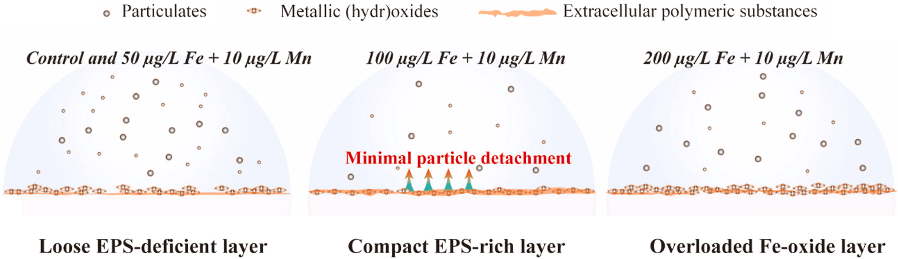
维持饮用水配水系统(DWDSs)的水质需要稳定的管壁界面,而铁(Fe)和锰(Mn)作为配水系统中最常见的金属,其累积常引发沉积物生长和黄水事件,但早期Fe-Mn沉积对管壁表面的物理化学影响尚缺乏系统阐明。本研究采用自设计电极监测水泥砂浆内衬管表面在受控Fe-Mn投加条件(50—200 μg/L Fe与10 μg/L Mn)下的电化学行为。结果表明,100 μg/L Fe与10 μg/L Mn的投加条件形成了致密且附着的沉积物,具有高电荷转移电阻(Rct=1.33×10⁶ Ω)和低腐蚀电流密度(icor=3.68×10⁻⁵ mA/cm²);该条件归因于以假单胞菌(Pseudomonas)为主导、氢噬菌属(Hydrogenophaga)和鞘氨醇单胞菌属(Sphingomonas)为共优势的凝聚性生物膜,其通过以同化为中心的碳氮代谢途径分泌大量胞外聚合物,使水体中颗粒态金属累积最小化。相反,过量Fe输入(200 μg/L)产生了鳞片状、含金属氧化物的沉积物,伴随Fe-Al含量升高、Rct降低(2.97×10⁵ Ω)、icor升高(1.70×10⁻⁴ mA/cm²)以及代谢多样但协调性弱的微生物群落。上述结果表明,Fe-Mn调控的形态—微生物组耦合塑造了早期腐蚀行为,适当的Fe-Mn水平对于促进稳定沉积物形成和保障长期饮用水安全至关重要。
Abstract
Maintaining water quality in drinking water distribution systems (DWDSs) requires resilient pipe-wall interfaces, yet the build-up of iron (Fe) and manganese (Mn), the most common metals in DWDSs, often initiates deposit growth and triggers discoloration events. However, the physicochemical impacts of early Fe-Mn deposition on pipe-wall surfaces have not been systematically elucidated. To elucidate their mechanistic role in the onset of scale development, self-designed electrodes were employed to monitor the electrochemical behavior of cement mortar-lined pipe surfaces under controlled Fe-Mn dosing (50–200 μg/L Fe with 10 μg/L Mn). Results showed that a dosing condition of 100 μg/L Fe with 10 μg/L Mn produced compact and adherent deposits with high charge-transfer resistance (Rct = 1.33 × 10⁶ Ω) and low corrosion current density (icor = 3.68 × 10⁻⁵ mA/cm²). This condition was attributed to cohesive biofilms dominated by Pseudomonas with co-dominant Hydrogenophaga and Sphingomonas, which, through assimilation-centered carbon and nitrogen pathways, secreted abundant extracellular polymeric substances, associated with minimized particulate metal accumulation in bulk water. In contrast, excessive Fe input (200 μg/L) generated scale-like, metal-oxide-bearing deposits accompanied by elevated Fe-Al contents, reduced Rct = 2.97 × 10⁵ Ω, higher icor = 1.70 × 10⁻⁴ mA/cm² and metabolically diverse but weakly coordinated microbial communities. These results demonstrate that Fe-Mn-regulated morphology-microbiome coupling shapes early-stage corrosion behavior and that appropriate Fe-Mn levels are essential for promoting stable deposits and supporting long-term drinking-water safety.
Keywords
Fe-Mn deposition; DWDSs; Self-designed electrodes; Morphology-microbiome coupling; Long-term drinking-water safety
【文章链接】https://doi.org/10.1016/j.jenvman.2025.128468