课题组邵富林同学于《Water Research》期刊上发表了题为《Screening toxic transformation products of emerging pollutants in advanced oxidation processes with 3D deep learning and in vitro assays》的论文。
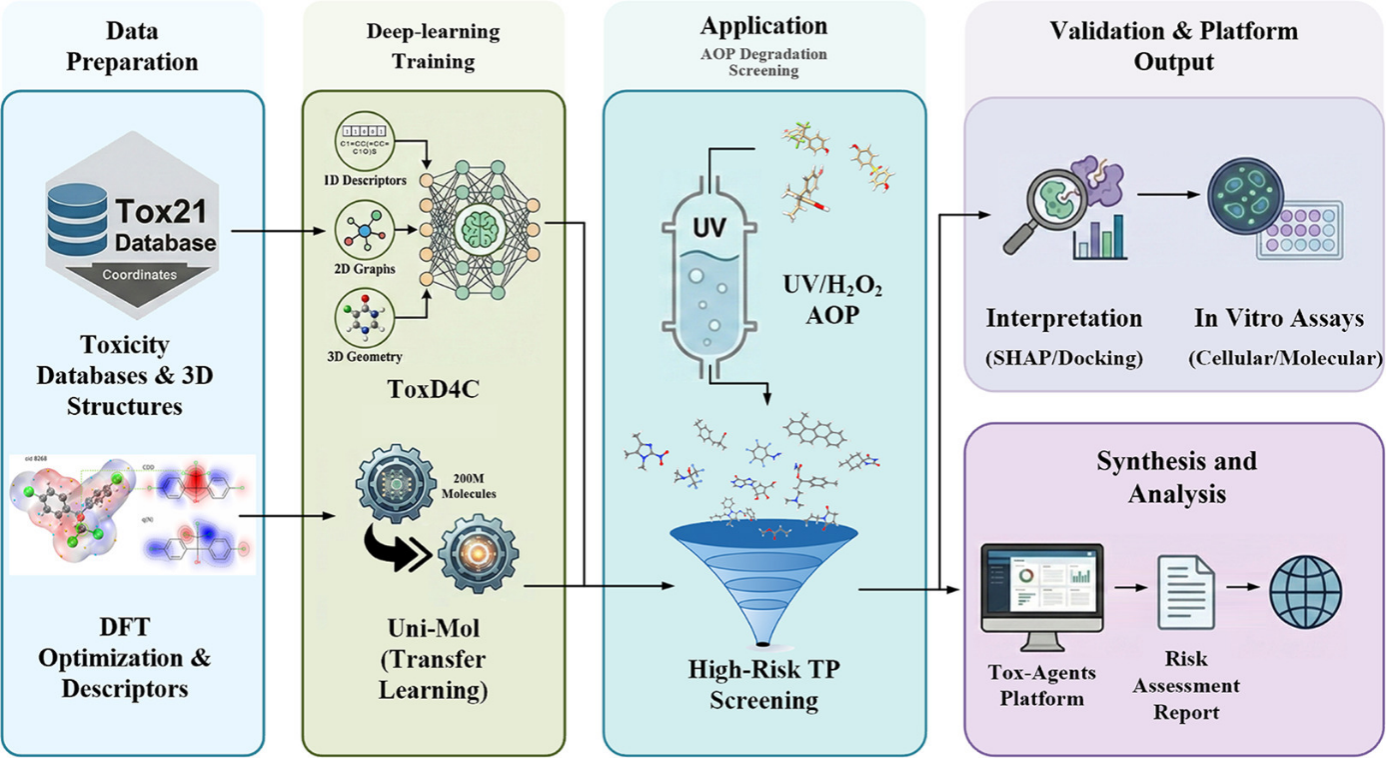
高级氧化过程(AOPs)在水处理中广泛应用,但污染物不完全矿化会产生大量毒性未知的转化产物(TPs),传统二维定量构效关系(QSAR)模型受限于简化分子描述符,难以准确预测其毒性。本研究开发了多模态深度学习框架ToxD4C,同时实现31个毒性终点的分类与回归预测,涵盖核受体与酶面板、应激反应、致突变性、致癌性、心肺毒性及水质管理关注的环境毒性等;该框架创新性地融合三维分子几何、图注意力网络和SE(3)等变Transformer架构,有效捕捉复杂立体化学与电子特征。同时,基于密度泛函理论(DFT)优化结构对预训练Uni-Mol模型进行迁移学习微调,独立生成归一化毒性预测,两种方法在验证测试中均优于传统描述符模型。SHAP特征归因分析揭示了预测毒性的关键理化驱动因素,受体对接为选定受体介导终点提供了机制背景。将该方法应用于真实水基质中UV/H₂O₂高级氧化场景,高效识别出高风险转化产物,并通过JC-1线粒体膜电位、CCK-8细胞活力及核受体/应激反应等体外实验验证了模型预测毒性。该研究为水处理过程中转化产物的快速毒性筛查和风险优先排序提供了可解释、可操作的計算工具。
Abstract
The rapid and precise toxicity assessment of chemical pollutants and their byproducts formed during water treatment and in aquatic environments remains a significant environmental challenge, as the predictive power of conventional quantitative structure-activity relationship (QSAR) models is limited by their reliance on simplified molecular descriptors. To address this, ToxD4C, a novel multi-modal deep learning framework, was developed to simultaneously classify and regress 31 toxicity endpoints, covering nuclear receptor and enzyme panels, stress response assays, mutagenicity, carcinogenicity, cardiopulmonary toxicity, and various environmental toxicities of concern for water quality management. ToxD4C uniquely integrates three-dimensional molecular geometries, graph attention networks, and SE(3)-equivariant Transformer architectures, effectively capturing complex stereochemical and electronic molecular features. In parallel, a pretrained Uni-Mol model was fine-tuned via transfer learning on Density Functional Theory (DFT)-optimized structures, independently generating normalized toxicity predictions with enhanced reliability and generalization. Both approaches outperformed traditional descriptor-based models across validation tests. Feature-attribution analysis (SHAP) highlighted key physicochemical drivers of predicted toxicity, and receptor docking offered mechanistic context for selected receptor-mediated endpoints. Applied to realistic UV/H₂O₂ advanced oxidation scenarios in a real water matrix, this approach efficiently identified high-risk transformation products, and their predicted toxicity was further validated in vitro using JC-1 mitochondrial membrane potential, CCK-8 cell viability, and nuclear receptor/stress response assays.
Keywords
Advanced oxidation processes; Emerging pollutants; Transformation products; Structure-toxicity relationships; Deep learning
【文章链接】https://doi.org/10.1016/j.watres.2026.125499