课题组周宇同学于《Water Research》期刊上发表了题为《Revealing the optimal ratio of aged-to-fresh carbon in BAC filtration: linking biofilm development, iDNA/eDNA community dynamics, and purification performance》的论文。
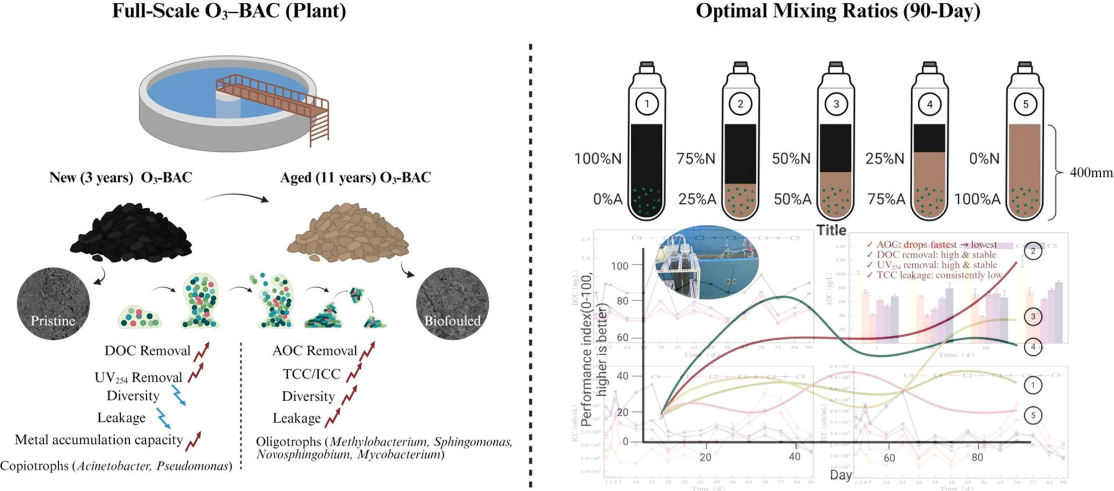
臭氧-生物活性炭(O3-BAC)过滤是饮用水深度处理的重要工艺,但活性炭更换策略尚缺乏明确依据。本研究以华东某水厂一对全规模O3-BAC滤池(新炭运行3年、老炭运行11年)为对象,并结合为期90天的实验室柱试验(新鲜炭比例0—100%)解析吸附—生物降解协同作用及微生物演替。全规模结果表明,新炭滤池对DOC和UV254的去除率分别为21.99%和20.14%,老炭滤池吸附能力较弱,但AOC去除率更高(22.67%),并释放更多细胞至出水(最高约2.2×10^5 mL^-1)。实验室结果显示,纯新炭早期吸附强但硝化启动慢、AOC下降延迟;纯老炭可立即提供生物降解但启动期细胞释放较高;中间配比可同步吸附与生物降解,其中75%新鲜炭+25%老化炭配置稳定最快,第90天残余AOC约20 μg/L,出水细胞浓度维持在10^3—10^4 mL^-1量级,并形成致密多样的生物膜。iDNA/eDNA及16S rRNA分析表明,混合炭床既保留了老炭中的硝化菌和芳香族降解菌,又在新炭上招募先锋定殖菌,3D-EEM证实其对蛋白类和腐殖类有机物具有广谱去除能力。研究建议采用部分更换而非全部更换,新鲜炭比例以50%—75%为宜,并以低且稳定的AOC、低且稳定的出水TCC/ICC以及UV254和DOC同步下降作为BAC运行管理指标,为饮用水厂活性炭可持续管理提供实践依据。
Abstract
Ozone-biological activated carbon (O3-BAC) filtration has been widely employed for water purification, yet guidance on appropriate strategies for carbon media renewal remains unclear. A pair of full-scale O3-BAC filters located at a water treatment plant in eastern China (new: 3 years; aged: 11 years) was investigated and verified with a 90-day lab-scale test comprising four columns spanning 0–100% fresh carbon to decipher adsorption-biodegradation interactions and microbial succession. In the full-scale system, the newer filter removed 21.99% of dissolved organic carbon (DOC) and reduced UV254 by 20.14%, whereas the aged filter, despite its weaker adsorption, removed more assimilable organic carbon (AOC, 22.67%) consistent with a mature biofilm but released more cells to the effluent (up to 2.2×10^5 mL^-1). In the laboratory, beds filled only with fresh carbon showed strong early adsorption but slower onset of nitrification and a delayed decline in AOC, while beds filled only with aged carbon provided immediate biodegradation but higher start-up cell release. Critically, intermediate replacement synchronized adsorption and biodegradation: the 75% fresh + 25% aged configuration stabilized fastest, drove residual AOC towards about 20 μg L^-1 by day 90, and maintained effluent cell concentrations on the order of 10^3–10^4 mL^-1 while developing dense, diverse biofilms. Microbial analysis showed that hybrid beds preserved nitrifiers and aromatic degraders from aged media while recruiting pioneer colonizers on fresh carbon, enabling broad-spectrum removal of protein-like and humic-like organics confirmed by three-dimensional fluorescence spectroscopy. These findings indicate that partial rather than full replacement, optimally 50–75% fresh carbon, can maximize organic pollutant removal and minimize microbial risks when BAC operation maintains low and stable AOC, low and steady effluent TCC/ICC, and concurrent declines in UV254 and DOC, providing a practical basis for sustainable BAC management under stringent drinking water standards.
Keywords
O3-BAC; Carbon replacement ratio; Biofilm; Microbial community dynamics; Drinking water
【文章链接】https://www.sciencedirect.com/science/article/pii/S0043135425021499